TRT Clinic vs. Telehealth vs. Your
PCP: Which Is Best?
An honest comparison of all three options — the real pros, cons, and costs of each approach to testosterone therapy.
You've decided to explore testosterone replacement therapy. Now comes a decision that most men don't think carefully enough about: where to get treatment. Your three main options are your primary care physician (PCP), a telehealth TRT company, or a dedicated TRT clinic. Each has genuine strengths and real limitations — and choosing the wrong option can mean overpaying, undermonitoring, or getting suboptimal care.
This guide provides an honest, side-by-side comparison. We run a TRT clinic, so we obviously have a perspective — but we'll give you the unvarnished truth about all three options, including ours, so you can make an informed decision.
Option 1: Your Primary Care Physician
The Pros
Your PCP knows your full medical history. They can evaluate low testosterone in the context of your other health conditions, medications, and overall health picture. If TRT is covered under your medical insurance, the office visit may be covered as well. Your PCP can also coordinate care with other specialists you see and manage the full range of health issues that might overlap with low testosterone — thyroid dysfunction, sleep apnea, depression, metabolic syndrome.
For men who have a great relationship with a PCP who is knowledgeable about hormone management and willing to run comprehensive labs, this can work well. The medication is prescribed to your local pharmacy and covered by insurance — the same process as any other prescription.
The Cons
Most primary care physicians receive minimal training in hormone management during medical school and residency. Testosterone therapy isn't a condition they manage frequently, which means they may be less comfortable with dosing optimization, estradiol management, hCG protocols for fertility preservation, or the nuances of interpreting a comprehensive hormone panel.
The lab work ordered by PCPs is typically limited — most will check total testosterone, CBC, and PSA (4 to 7 markers). They often skip free testosterone, SHBG, estradiol, LH, and other markers that are essential for understanding the full hormonal picture. Follow-up intervals may be longer (every 6 to 12 months rather than 6 weeks after starting), and appointments are typically 15 minutes — not enough time for the detailed discussion that hormone optimization requires.
Perhaps most importantly, many PCPs are hesitant to prescribe TRT at all. Some have outdated concerns about cardiovascular or prostate risk (now largely resolved by the TRAVERSE trial and saturation model research). Others simply don't feel comfortable managing a therapy they're not specialized in. The result is that men often leave their PCP's office with a "your testosterone is normal" verdict, even when their levels are in the low-normal range and they're clearly symptomatic. For more on navigating this conversation, read our article on how to talk to your doctor about low testosterone.
Option 2: Telehealth TRT Companies
The Pros
Convenience is the primary advantage. You can sign up from your couch, have a video consultation, and receive medication shipped to your door. For men in rural areas without nearby TRT clinics, telehealth provides access to treatment that wouldn't otherwise be available. The onboarding process is typically fast — many companies can have you evaluated and prescribed within a week. Telehealth has also done a remarkable job of raising awareness about low testosterone and reducing the stigma around seeking treatment.
The Cons
The limitations are significant. No physical exam — you're evaluated through a screen, which means thyroid nodules, testicular abnormalities, blood pressure issues, and other physical findings are missed. Lab work is typically basic (4 to 7 markers), missing free testosterone, SHBG, estradiol, and other critical values. You often see a different provider at each follow-up, which eliminates the continuity of care that allows a physician to spot trends and personalize treatment over time.
But the biggest issue is cost and pharmacy model. Telehealth companies prescribe compounded testosterone — custom-mixed by their own pharmacy or a partner pharmacy — rather than FDA-approved testosterone from your local pharmacy. This means your insurance can't cover the medication, and you're paying $100 to $250 per month for the same active ingredient that costs $0 to $30 at Walgreens with insurance. Over a year, this adds up to $1,000 to $2,500 in unnecessary medication costs. For a detailed explanation of why this matters, read our article on compounded vs. FDA-approved testosterone.
The clinical quality of telehealth TRT also varies widely. Some companies employ licensed physicians who provide thoughtful care within the telehealth constraints. Others essentially operate as prescription mills — a brief questionnaire, a rubber-stamp video call, and medication shipped with minimal ongoing oversight. The pressure to convert evaluations into subscriptions creates a financial incentive to prescribe, which can conflict with the clinical judgment to sometimes not prescribe.
Option 3: Dedicated TRT Clinic
The Pros
A dedicated TRT clinic combines specialization, comprehensive testing, in-person evaluation, and — at the right clinic — insurance-compatible prescribing. Here's what this looks like at Revive.
Every patient receives a comprehensive 51-analyte lab panel — not just total testosterone, but free testosterone, SHBG, estradiol, LH, FSH, prolactin, DHEA-S, cortisol, thyroid function, iron studies, lipid panel, metabolic panel, HbA1c, vitamin D, PSA, and more. This isn't a premium upgrade — it's the standard of care for every first visit. Labs are drawn in-house at the same appointment, no separate lab visit required.
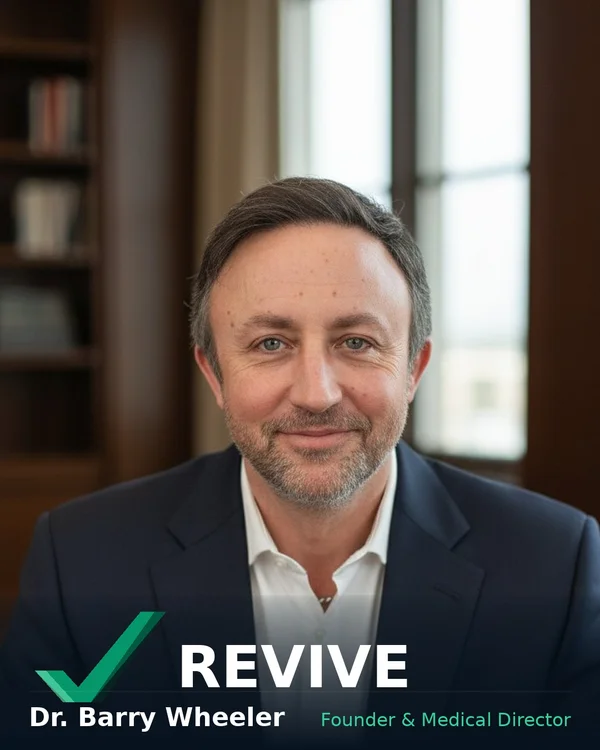
Every patient gets a physical examination by a licensed physician who specializes in hormone management. Dr. Barry Wheeler and Dr. Chris Merlino have treated thousands of men with low testosterone — this is what they do every day. You see the same physician at every visit, building the kind of continuity that allows for nuanced, personalized care. Injection training is hands-on, taught in person by clinical staff who walk you through the process and ensure you're confident.
And critically, we prescribe FDA-approved testosterone to your local pharmacy — Walgreens, Costco, CVS, or wherever you prefer. Your insurance can cover the medication, and most patients pay $0 to $30 per month for testosterone. We handle any prior authorization paperwork. The result is comprehensive, specialist-level care at a lower total cost than most telehealth subscriptions.
The Cons
In the interest of honesty: in-person clinics require you to physically visit the office for appointments. For men who live far from a clinic location, this is a genuine inconvenience. Revive currently has three locations in the Seattle metro area (Seattle, Kirkland, and Federal Way), but if you're in a rural part of the state, the travel time is a real factor. There's also the time commitment of in-person visits versus a 10-minute video call.
The clinic membership fee is also a separate cost from your medication. While the total cost (membership plus insurance-covered medication) is typically less than what telehealth companies charge for medication alone, the membership represents a regular expense that some men may need to budget for.
The Side-by-Side Comparison
| Your PCP | Telehealth | TRT Clinic (Revive) | |
|---|---|---|---|
| Lab Markers | 4–7 | 4–7 | 51 |
| Physical Exam | Yes | No | Yes |
| Physician Expertise | General | Varies | Specialized |
| Same Provider Each Visit | Usually | Rarely | Always |
| Insurance-Covered Rx | Yes | No | Yes |
| Monthly Rx Cost | $0–30 | $100–250 | $0–30 |
| Injection Training | Sometimes | Video only | In-person, hands-on |
| Follow-up After Starting | 3–6 months | 6–12 weeks | 6 weeks |
The Total Cost Picture
When comparing options, look at total annual cost — not just the monthly subscription or copay. Here's how the math typically works for the first year:
PCP route: Copays for 2 to 4 visits ($20 to $50 each) + separate lab costs ($100 to $400 depending on insurance) + medication copay ($0 to $30/month). Annual total: roughly $300 to $900. Lowest cost, but with limited lab work and expertise.
Telehealth: Monthly subscription ($150 to $300/month, which typically includes medication and periodic labs). Annual total: $1,800 to $3,600. Convenient, but compounded medication locks you out of insurance and the monitoring is basic.
TRT clinic (Revive): First visit $99 + membership ($35 to $269/month depending on plan, which includes labs and physician visits) + medication at pharmacy ($0 to $30/month with insurance). Annual total: $519 to $3,587 depending on plan level. Comprehensive care with insurance-covered medication and full monitoring. Visit our pricing page for detailed plan information.
Who Should Choose What
Choose your PCP if: You have a physician who's experienced with hormone management, willing to run comprehensive labs, and available for the follow-up frequency that TRT requires. This is less common than you'd hope, but when it works, it's a good option.
Choose telehealth if: You live in a rural area without access to a TRT clinic, you need the absolute maximum convenience, and you're comfortable with the trade-offs in lab comprehensiveness, physical examination, and higher medication costs.
Choose a dedicated TRT clinic if: You want the most comprehensive testing and monitoring, you value seeing the same physician at every visit, you want insurance-covered medication, and you live within reasonable distance of a clinic location. This is the option that combines the best elements of both PCP care (in-person, physical exam, insurance prescribing) and specialized care (comprehensive labs, hormone expertise, dedicated follow-up).
Want a more detailed comparison? Our side-by-side comparison page breaks down every difference between Revive and the major telehealth TRT providers — including lab scope, pharmacy model, physician credentials, and total annual cost.
The Best of Both Worlds
Specialist expertise. Comprehensive labs. Insurance-covered medication. Book your first visit for $99 and experience what comprehensive TRT care actually looks like.
Book Your First Visit →Or call us: (206) 960-4770 · Seattle · Kirkland · Federal Way